JoAnne and I just returned from Photo East after not making it for the past 4 years because we were either on assignment or out-of-the country. We had several important meetings with people who were in town specifically for the show so it was a good time to connect. I had dinner with Jeff from Lexar, and we met with Brandon and Chris from Cru-Dataport. I had breakfast with Brian and Gvantsa from Adorama as well as breakfast with Photographer Mark Wallace who is a great guy, Rich Harrington, and Robert Vanelli from Rhed Pixel. At the show we saw Rudy from Canon, Chris from Manfrotto, Monica from Adorama, ran into Michelle from Pop Photo, Rick from Tiffen as well as Patty from Domke. We saw Peter and Jim from Dynalite, and Herman from Adoramapix, stopped by to see Brandon at Cru-Dataport again, and lastly stopped to say hello to Sam from Nikon. Sorry to anyone I left out but this is the second time I wrote this blog as it disappeared on me and I’m a little frustrated with not having electricity in our studio since Monday afternoon and blogging on the road. I’ve had enough! That’s also the reason for the lack of photos as I can’t access them.
Category Archives: Uncategorized
So Who Do I Ask?
Here’s the Question – Bert who do you like in the Chavez vs Martinez Fight? Imaginary Answer – “Uncle Joe what’s wrong with you and how many years have you followed boxing? How many world championship fights have you photographed and you come to me for the answers?” Bert speaking, ” if I’m not mistaken at one point, you almost had a perfect record in guessing the outcome of a boxing match – well maybe not perfect, you may have gotten one or two right out of 60 or 70 fights. The big joke at the fights was – whoever DiMaggio picked the other guy was sure to win.” “So now you come to me and the “Bertster” is suppose to have the answer. Well Uncle Joe, Sergio Martinez is going to take him apart like a cheap suit. Unless of course, he gets real lucky with an overhand right. Enough of this foolishness, I have three deadlines and I will see you at the fight.”
Bert, I genuinely miss you so I’ll smoke a cigar and have a double Cutty Sark and yes, I won’t be wearing socks.
The fight game will never be the same without you. No disrespect to Roy Jones Junior
Smokin’ Joe
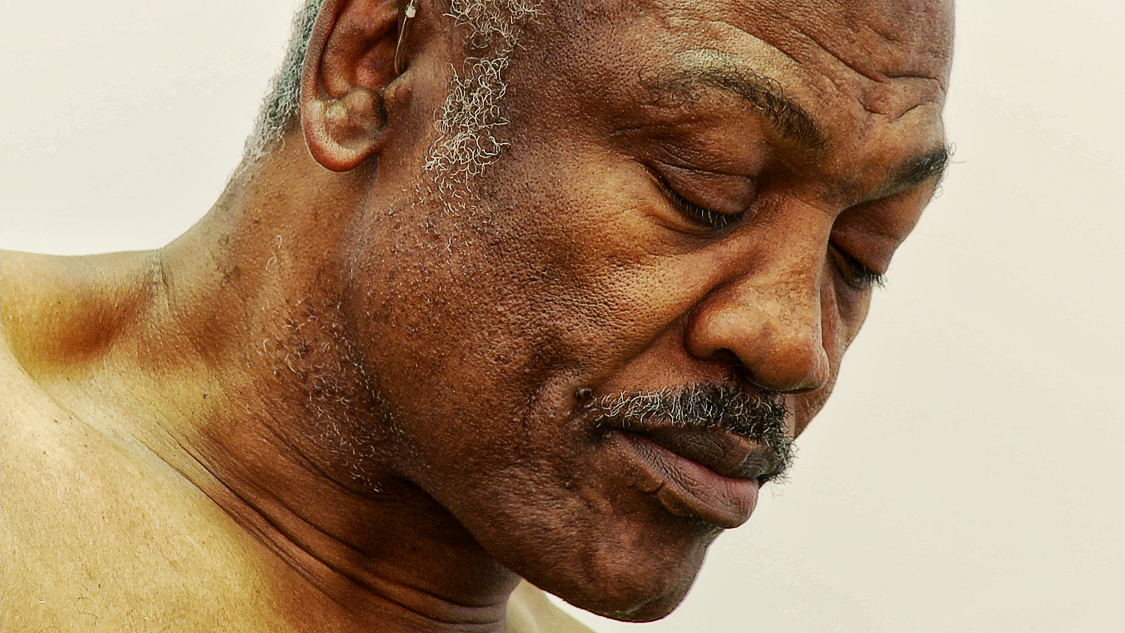
I remember the first day that I photographed Smokin’ Joe Frazier; March 8 1971. Frazier was the heavyweight champion of the world, fighting the great Muhammad Ali (off a three year hiatus from boxing). To say the least, it was considered the fight of the century, with Frank Sinatra shooting ringside for Life Magazine. I’ve been known to say “The next time I’m in Vegas, I’m gonna jump onstage and grab a microphone—not”. over the years, Frazier and I became casual acquaintances. Joe was a true gentleman. There are very few people that ever had a bad word to say about Joe. I asked him if he would be kind enough to allow me to interview him for my documentary In This Corner, and he agreed. We met at the iconic Gleason’s Gym. Honesty is the best policy, and as far as the interview went it was two warriors talking about the good old days, and from that we talked about the future of boxing in the new decade. The interview became very personal, and that is not the proper way a documentary interview should go. I looked at it yesterday and a tear came to my eye. When I get my head put on straight, I’ll do a second and a third blog with some action photography. Yes, I know this should have been done November of last year, but it took me that long to actually find the images I was looking for. So much for my filing system. To all the ships at sea, some photography, for that matter all photography, is timeless. On that note, go out and make some great photos. Joe D.
I Really Did Invent the GoPro—NOT
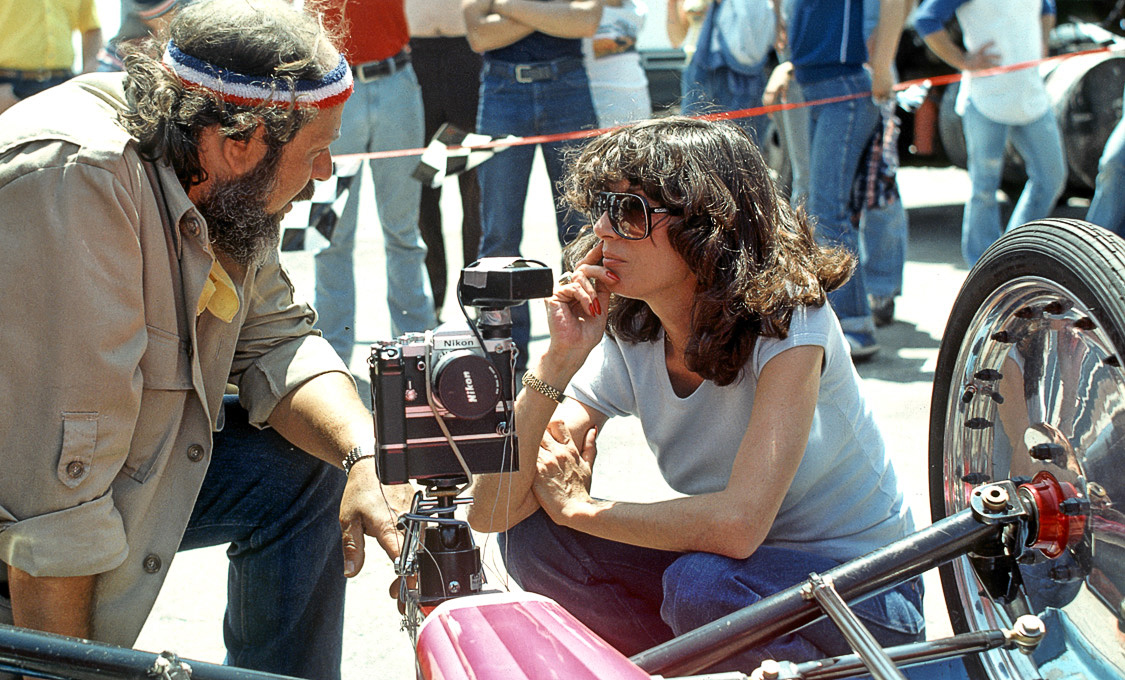
We always want photography to be fun; if it’s not fun then why do it? On an assignment for Sports Illustrated on the first great woman drag racer of our times, Shirley Muldowney, I spent a week with her and it was just pure fun. It was after her horrific crash in 1984, yet she maintained a light, airy persona and was genuinely warm, friendly, and cooperative; until I mentioned that I wanted to mount a camera on the nose of her Top Fuel Dragster. In many ways, Shirley was a hero to me. She was a great spokesman for the sport, and a great role model for women. On the first run with the camera mounted on the nose of the Dragster, the torque and power snapped a quarter twenty bolt and the camera fell over and almost hit the cement. The safety wire stopped it from becoming a photographic hand grenade. On that note, let’s always remember; safety first, photography second. After talking with her engineer we decided to take the nose cone off and bolt the camera directly to the rail. The camera we used was a Nikon F with motor and a 16mm lens. Photos were taken on Kodachrome 64 with an exposure of f16 at 1/60 of a second, tripped with an old fashioned module light.
The Tomcat
There are rules, and there are new rules. The new rule is to never look backwards, instead always look forwards. I’m starting to get it; it takes a while but no one ever said I was a fast learner. While searching the archives for my new book, I stumbled across a story I did for Time Magazine on the last F-14 Tomcat that was to be built. The story was very important to me, but I had no idea how important it would actually be. I absolutely fell in love with the Tomcat. I believe the basic design was done in 1966 and it’s been improved upon and modified scores of times ever since. When you talk to pilots about two planes, their eyes will light up; one of those planes is the P-51, and the other the Tomcat. I had the pleasure of meeting and photographing Chuck Yeager at the Reno Air Races and he watched me climbing out of the P-51 Precious Metal. Without me asking a question, he smiled and said “You know what I like about that damn plane? You can fly it 300 feet off the ground, hit the stick and make a hard left around a barn. With these damn new planes, if you want to do that you’ve got to fly to a different state before you can make a left”. We both laughed. I will follow up on Precious Metal next week. To all the ships at sea, let’s go out and make some photos. Check out my Adorama TV show.
http://www.youtube.com/watch?v=t3YFNXjr-5M&feature=plcp
Photo above: Canon film camera; yes, I don’t remember which one, 14mm lens, on top of a cherry picker, ASA (ISO) 64, 1/15 of a second, at 2.8
Photo below: Canon camera, 300 2.8 lens, ISO 64, 1/100 of a second, at 2.8
Tucson Firefighters
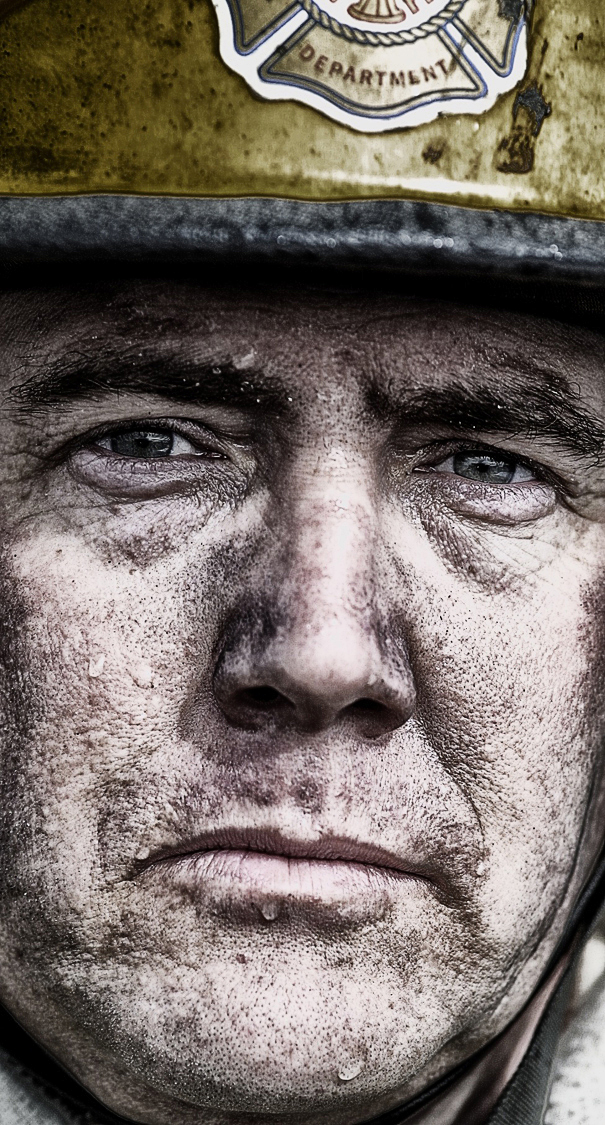
To all the ships at sea, until all of the photographs are found for my new book, you’re going to see an awful lot of blogs like this. For about ten years of my life, I spent two or three months a year teaching workshops at The U of A, and I had an opportunity to work with one of the greatest fire departments in the United States. Men and women who are dedicated to saving lives; every day knowing that they would be willing to trade their life to save yours. It takes a very special person to do that. I doubt very much that I could ever be able to do something like this, certainly not on a regular basis. It would me remiss of me to say all of our fire departments and firefighters are extremely special human beings. You know I’m not a big Photoshop guy, but I played a little bit with this.
Equipment: Canon D30, 200mm 1.8, ISO 100, 1/640 of a second, f2.8
Dynalite Makes Its Own Light
To all the ships at sea, if there’s one thing I’ve learned in my years as a photographer and filmmaker, it’s that I don’t have all the answers. Hopefully, I’m smart enough to go to the people that do have the answers. Peter Poremba, the CEO, president, and senior electrical engineer of Dynalite was kind enough to go to Malibu on two separate occasions, and with the minimum amount of equipment he was able to light 30% of the arena: just one light and one power pack (if it was for SI, he would have brought in six power packs and eight lights). The combination of the electronic flash and the hypersync on my Canon 7D and Peter’s Nikon D7000 made for some photos that could not be taken back in the day. Some of the other photos in this blog I threw in just because I wanted to, will have a follow up.
Tech information: triggering device was the new Pocket Wizard Flex, power pack MP800, SH2000 Studio Head, SP-45 reflector, Nikon 85mm 1.4 lens, Canon 135mm lens.
Nikon D7000 exposures: 1/800 of a second, ISO 400, f4
Canon 7D exposures: 1/1200 of a second, ISO 500, f4.5
Black and White
To all the ships at sea; we very rarely see a photograph of JoAnne and I together because most of the time she’s working on one specific project and I on another. The one good thing is we always agree; she says black, I say white, she says up, I say down. It makes for one hell of a relationship. Artistically, it really works. She is an extremely fine photographer and a difficult producer. As for me; best described as pain in the ass. It’s a tough job, but somebody’s got to do it. Recently, there’s been a new artist community social network organization, the Milford Arts Alliance Open Gallery Tour, and we’ve had our first gallery opening for them which was extremely successful. A total of 60 clients came through with four sales. Great conversation; I thoroughly enjoyed it. A big thank you to Amy Bridge and her publication The Milford Journal, and a big thank you to Micheal Hartnett for a great photo. Have a great weekend.
I Invented the GoPro— NOT
One of the greatest assignments I had an opportunity to do was a three-week assignment for Sports Illustrated on three brothers, the Whittington brothers, who inherited nine hundred million dollars. They had an affinity for cars, planes, and all things exciting. Their 1979 Le Mans entrance won first in their class. A small part of my assignment was to have the three cars together at speed, so I ordered a Mitchell mount from California, mounted a Nikon f2 with a motor with a 15mm lens, and a remote cord into the compartment where I sat on four roll bars. I explained that we only needed to go 40 to 50 miles an hour. Unfortunately, race cars like to grip at much higher speeds. We did one pass at about 100 miles an hour, I changed film, and on the second pass, I could feel the remote button and my camera was out of film. I believe my quote was “we can go back to the pits, I’m done”. I will never ever use those words again. Bill Whittington kicked in the turbo and we went from 100 to 160 in what seemed like a millisecond, until the rear end broke loose (please keep in mind, he had on his Nomex, his balaclava, his gloves, his helmet, and all of his racing belts. I had beech nut gum and a death grip on the roll cage). He took the emergency road, locked up all the brakes, came to a full stop, popped out of the automobile and I was still frozen. Paul Newman looked over and said to me “You must be out of your mind to get in a car with that wild man”. Once again, Paul was right.
As everyone knows, I was brought into the digital world kicking and screaming. Now that I’m working on my memoirs, I realize what I did with this series cost several thousand dollars and someone could have gotten hurt (namely me). In the world of digital, using two GoPros, one on the front and one on the back of the car would’ve been safer. I don’t have to be in the car, so if they would like to do 180, so be it. The overall cost would be less than $600 with a safety wire. God bless digital.
Shot at 1/15th of a second on Kodachrome 25 at f11.
Hannah
I had an opportunity to photograph Paul Newman six or seven times. One of the most beautiful things about Paul is he was a regular guy. He rolled up his sleeves (sometimes a sleeveless T-shirt), got dirt under his fingernails, and treated everyone as if they were his equal. Not pretentious, not a superstar (but of course he was!). In an impromptu environmental portrait I asked him why he was so comfortable in front of the lens; whether it was film, or film. He said to me when he was making a photograph, he tried to put the person at ease by saying “You’re beautiful, and you’re as pretty as you feel”. Please understand I didn’t tape record the conversation, so obviously, I’m leaving a few things out. He then said to me “Sometimes the camera falls in love with the person you’re photographing, and you cannot make a mistake. If the camera loves you, it’s all good”. Hannah is obviously no Paul Newman, but the camera loves her. I always remember that I am not the most important part of the photo; it’s all about the person you’re photographing, both their inner beauty and their outer persona.
Equipment used: Canon 7D camera, 24/105 zoom 100 macro lens, Dynalite 500 watt second Powerpack, studio head rhyme light, octagon modifier, Dynalite bare bulb, two silver reflectors, and a Manfrotto air lightstand.
ISO 100, 1/200th of a second, f8.