Wine Gets Better with Age

“I was a young lad when I met Joe and JoAnne, I was a junior (maybe) in high school, showed up at their waterfront house to interview. Thought JoAnne was his daughter, good thing I kept my mouth shut and didn’t say that. They’ve become more of my second family rather than a job, and that’s why I never truly got fired. I processed black and white film and printed,(my 14-year-old asked “whats a darkroom?”) stamped color slides for days on end, drove cool cars, traveled and sat ringside at the Cooney Holmes championship fight. Fished, moved them to the sticks and idealized all they did (almost All). Love you guys dearly, I don’t blog but that’s all”

Andrew started with both JoAnne and myself when he was 15 years old. He loaded my cameras at heavyweight champion fights. Over the years, we all became very close friends and now the relationship has grown into absolute family. He has an extraordinary family, beautiful wife, children and is extremely successful in his business. He has taken photography, his original passion, to a whole new level. He has a brutal schedule. His passion is so strong, that he will drive two hours in one direction, shoot for half an hour and drive three hours back in traffic. Not only to make a great photo, but it becomes a zen like experience.

Of course I told him he was out of his mind to do that. Thank God he doesn’t listen to me all the time. To this day, if I called Andrew and said, I have a 6 figure assignment and I need your help, he would come out of retirement, (there’s no doubt in my mind) he would drop what he was doing and join me anywhere in the world. If I told you once, I told you a thousand times, I’m the luckiest guy in the world. The following two photographs, well they need not be explained. Photo tip for today: take what you really like, turn it into a passion. You’ll make great art, and maybe take a little stress out of your life. His black and white photos motivated me to go out and shoot some serious black and white.

This image is shot in raw, processed w. silver efex pro and Lightroom. Nova Scotia, Peggys Cove, Lighthouse.
Andrew_Coast_Stormy

©Andrew Elrich

©Andrew Ehrlich

All the Best,
Joe D

Visual Impressions with Joe DiMaggio, Sponsored by Adorama
www.adorama.com
Adorama Learning Center

Talk About a Small World

Hi to all the Ships at sea,

On a recent trip overseas, I and a young gentleman, who attended one of my lectures, discovered that we both know about 15/20 mutual friends. Furthermore, we were probably in the same press room for an awful lot of fights and baseball games, so please let me introduce you to Sheldon Saltman. He’s got some great talking points. The following football photo has nothing to do with Sheldon’s blog, I just decided to post a football photograph.

©Joe DiMaggio

©Joe DiMaggio

Sheldon Saltman:
I do not know about you dear reader, but as I write today’s column, my eyes are still blurry and maybe a little cross-eyed from watching so many different sports over the past week. It started with NBA Basketball and not to be left behind, there were some terrific College Games. You would think that would be enough, but then the NCAA Football Bowl season began. When I was a kid, it was easy. We only had the Orange, Sugar, Cotton and Rose Bowls. Today, it is quite different! I think I counted over 35 actual Football Games with the title “Bowl” as part of their name. You couldn’t name them all, even using both your hands and taking your shoes and socks off. I believe, every sponsor in this down economy that had extra cash lent his/her name to a Bowl Game. My Dad, the old footballer who was in the meat business, always thought there should be a “Sausage” Bowl. I didn’t see that one. But Dad if you are looking down don’t hold your breath. I think there probably will be a “Kitchen Sink” Bowl”, before one entitled “Sausage”. Nevertheless, there were some great games and some exciting record chases. One of those was that of Adrian Peterson of the Minnesota Vikings chasing the record of Eric Dickerson. In 1984 while playing for the Los Angeles Rams. He ran for 2105 yards. Peterson was closing in and Eric was interviewed on many shows about how he felt about Peterson possibly breaking his record. Eric’s answer was simple and honest. Eric said, “I hope he continues to have a great season, remains unhurt and his team does well. I hope he does not break my record.” This past weekend, Eric’s prayers were answered. In a game against Minnesota’s arch-rivals, the Green Bay Packers, Adrian ended the season just 8 short of Eric’s record, accumulating 2097 yards. For the moment, I am sure Adrian is heartsick. However, when he understands that in the long history of the NFL only 5 others have run for 2000 yds., or more, in a season, he will realize his achievement. O. J. Simpson was the first to do it in 1973 with 2003 yds. Realizing that I had been with the Los Angeles Lakers Organization during the 1971-72 season, I was bombarded by questions about the Los Angeles Clippers 17 game win streak. I thought about what Eric had said when he wished Peterson all the best, but not the record. The Clippers are good and they have captured the imagination of the Basketball World. The reason I was asked so many questions was during the ’71-’72 season when the Lakers won 33 straight games. After losing to the Golden State Warriors on October 31, 1971, they did not lose again until January 11, 1972. It was the Milwaukee Bucks with Kareem Abdul Jabaar who did them in. The same Kareem who would lead the Lakers to many more titles. However, the Lakers’ first title was in the ’71 season under Coach Bill Sharman. Bill, himself a Hall-of-Famer as both a Player and Coach worked with such intensity that he completely lost his voice. Today, at 86, he still whispers to communicate. That Laker Team was loaded with Hall-of-famers: Wilt Chamberlain, the only man to ever score 100 points in an NBA game. Jerry West whose shooting style today remains the NBA logo and Elgin Baylor with his famous “floating-in-air” shot. Carrying on that 1971 wining legacy is Pat Riley …at that time, probably the best 6th man in the NBA. He didn’t look like the suave executive of today. Instead, he had long flowing hair with mustache to match. But before every game he would take anyone he could find in a game of H-O-R-S-E. I never beat him. Today’s Clippers may also have one, or two potential Hall-of-Famers.

But for now, I breathe a sigh of relief. For the Laker Record, that I enjoyed as part of the organization, still stands.

All the best,
Joe D

Visual Impressions with Joe DiMaggio, Sponsored by Adorama
www.adorama.com
Adorama Learning Center

Yuri Foreman in the Spotlight

©Joe DiMaggio

©Joe DiMaggio

Hi to all the Ships at Sea,

Yuri, one of the protagonists in my full length documentary film, “In This Corner”, has started his long, arduous road back in hopes of securing his hundred and fifty-four pound title, with a one-sided win, at BB Kings last Wednesday. Personally, I’d like to wish Yuri all the luck in the world. For those of you who don’t know, when Yuri’s boxing career is over he will become an Orthodox Rabbi.

All the best,
Joe D

Visual Impressions with Joe DiMaggio, Sponsored by Adorama
www.adorama.com
Adorama Learning Center

Formula One Archives

©Luca Bruno

©Luca Bruno

© 2012 Joe DiMaggio

© 2012 Joe DiMaggio

Hi to all the Ships at Sea,

Much to my surprise, while I was going through the CORBIS archives on the Formula One photographs on the Austin, Texas race, there was a shot of the back of my head and my ponytail photographing Scuderia Ferrari, Fernando Alonso, and of course the beautiful American flag on my back. It was an honor to be assigned to shoot the race. I take my beret off to Luca Bruno, a world-class shooter who captured this moment. He knows a great ponytail when he sees one.

All the best,

Joe D

Visual Impressions with Joe DiMaggio, Sponsored by Adorama
www.adorama.com
Adorama Learning Center

W. Eugene Smith Interview

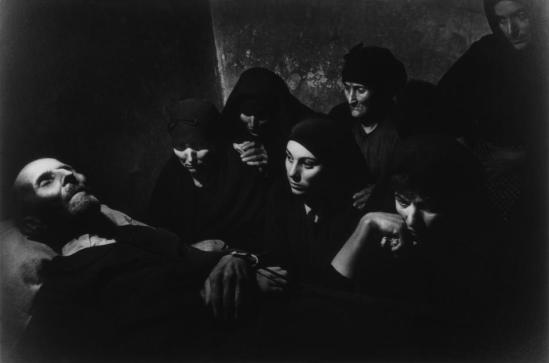
"The Wake", Eugene Smith, Published in the April 9, 1951, issue of Life

“The Wake”, Eugene Smith, Published in the April 9, 1951, issue of LIfe

Hi to all the ships at sea,

I tend to repeat myself, so once again, I will take the liberty to repeat myself. I am definitively the luckiest person in the world. I had an opportunity to assist Gene Smith, travel with him and yes, on occasion, have a mild cocktail or two. Smith taught me more about communication, dedication and the importance of an image than I could ever learn from a book or for that matter any other teacher or mentor. That is not to say, that there aren’t other amazing teachers, photographers and mentors. In my opinion, he was God when it came to a photograph. I don’t think there’s ever been anyone better, and I wish he was alive today. I guarantee you, he would be doing documentary films like no one else. Gene is still in my rolodex, I refuse to take him out. There is no doubt in my mind that I disappointed him many times. I will do everything humanly possible in the time I have left on this earth to revisit, remember and implement what he taught me. Thank you Gene, I still love you.

The following interview is from http://lens.blogs.nytimes.com/2013/01/03/w-eugene-smith-i-didnt-write-the-rules-why-should-i-follow-them:

W. Eugene Smith: ‘I Didn’t Write the Rules, Why Should I Follow Them?’

By the mid-1950s, W. Eugene Smith had established himself as the premier photo essayist at Life magazine by creating “Country Doctor,” “Spanish Village” and “Nurse Midwife.” In 1955 he left Life, joined the Magnum photo agency and began his exhaustive documentation of Pittsburgh.

The American Society of Media Photographers recently discovered the transcript of an interview of Mr. Smith, conducted by the great portraitist Philippe Halsmann and the society’s first president. The interview apparently took place in New York during an American Society of Media Photographers meeting in 1956, although the organization is unsure of the date. The transcript has been lightly edited.

Their conversation covered a variety of topics. In particular, however, Mr. Halsmann asked about staging photographs, a then-controversial practice that is now taboo in documentary and journalistic photography. Mr. Smith defended the practice in certain circumstances.

Q.
Where were you born?

A.
Kansas.

Q.
You know that Alfred Adler, the discoverer of the inferiority complex, believes the youngest child has a sense of inferiority which forces him to prove his own value. Do you feel this to be true with your own personality?

A.
Definitely.

Q.
Did you go to school in Kansas?

A.
Frequently.

I had a photographic scholarship at Notre Dame — which they created for me. But after a while, I found I was asked to do only commercial, publicity photos, and so — I had to quit.

Q.
Why are you a photographer?

A.
I discovered that saturated hypo was good for my poison ivy. Now, Groucho.

I fell into photography through my desire to design aircraft. I met a fine news photographer, Frank Knowles, who encouraged me.

I don’t think I became a real photographer until I made a real acquaintanceship with music. That’s why I make my layouts the way I do. Photography happens to be my means of communication. But I do not feel I am a photographer singular. I feel that my art or my necessity is communication, and this could apply to many branches of the communicative art — whether it be writing or photography.

Since I am somewhat adequate as a photographer, I remain with it. I am probably more in command of it than any other medium. I respect it highly as a medium. It has its own very definite purpose.

Q.
When do you feel that the photographer is justified in risking his life to take a picture?

A.
I can’t answer that. It depends on the purpose. Reason, belief and purpose are the only determining factors. The subject is not a fair measure.

I think the photographer should have some reason or purpose. I would hate to risk my life to take another bloody picture for the Daily News, but if it might change man’s mind against war, then I feel that it would be worth my life. But I would never advise anybody else to make this decision. It would have to be their own decision. For example, when I was on the carrier, I didn’t want to fly on Christmas Day because I didn’t want to color all the other Chistmases for my children.

Q.
I remember particularly your pictures of a Spanish wake [above], of people looking at the dead man’s face — how many exposures did you make?

A.
Two, and one to turn on. I didn’t wish to intrude.

Q.
[Piero] Saporiti, the Time-Life correspondent in Spain, told me once that you had used petroleum lamps.

A.
Saporiti has a marvelous memory, so imaginative! This was my version of available light. I used a single flash in the place of a candle.

Q.
Here were people in deep sorrow and you were putting flash bulbs in their eyes, disturbing their sorrow. What’s the justification of your intrusion?

A.
I think I would not have been able to do this if I had not been ill the day before. I was ill with stomach cramps in a field and a man who was a stranger to me came up and offered me a drink of wine which I did not want, but which out of the courtesy of his kindness, I accepted. And the next day by coincidence, he came rushing to me and said, “Please, my father has just died, and we must bury him and will you take me to the place where they fill out the papers?” And I went with him to the home and I was terribly involved with the sad and compassionate beauty of the wake and when I saw him come close to the door, I stepped forward and said, “Please sir, I don’t want to dishonor this time but may I photograph?” and he said, “I would be honored.”

I don’t think a picture for the sake of a picture is justified — only when you consider the purpose. For example, I photographed a woman giving birth, for a story on a midwife. There are at least two gaps of great pictures in my pictures. One is D-Day in the Philippines, of a woman who is struggling giving birth in a village that has just been destroyed by our shelling, and this woman giving birth against this building — my only thought at that time was to help her. If there had been someone else at least as competent to help as I was then, I would have photographed. But as I stood as an altering circumstance — no damn picture is worth it!

Q.
I remember your picture of a Spanish woman throwing water into the street. Was this staged?

A.
I would not have hesitated to ask her to throw the water. (I don’t object to staging if and only if I feel that it is an intensification of something that is absolutely authentic to the place.)

Q.
Cartier-Bresson never asks for this…. Why do you break this basic rule of candid photography?

A.
I didn’t write the rules — why should I follow them? Since I put a great deal of time and research to know what I am about? I ask and arrange if I feel it is legitimate. The honesty lies in my — the photographer’s — ability to understand.

Q.
Why do you print your own pictures?

A.
The same reason a great writer doesn’t turn his draft over to a secretary… I will retouch.

Q.
Avedon said that there are three steps in making a photograph: first the taking of the pictures, then the darkroom work, then the retouching. He showed me one unretouched picture in which the girl’s skirt fell straight; in the final version it was flying out.

A.
I would have gotten her skirt up somehow.

Q.
How much did your Pittsburgh Opus cost in time?

A.
It cost the lining of my stomach, and much more beside. … While working on it I resigned (from a certain unnamed picture magazine).

[At this point in the transcript, the Q. and A. format is broken, though it goes on: “After questioning back and forth, Philippe pinned him down to this: Smith had explained that he had worked on the opus for a period of several years, which included three months that he was on staff, which he considered ‘stolen.’ ”

“There’s no way to evaluate it,” Smith said. “If I was able to print exclusively, it still would take at least a year. I now have 200 prints from 2,000 negatives….”]

Q.
[The transcript resumes as before.] What would anybody in the world do with 200 prints?

A.
Each print I have made represents a chapter — the 200 represent a synthesis.

Q.
You won’t put any time limit on this work?

A.
It was also sidetracked for a period of time for doing an almost equally difficult color project — one of my worst failures, which I consider a going to school.

Q.
How can this be financed? Is there any way, here in America today, to pay a man back for this work?

A.
How long did it take Joyce to do “Ulysses”? I could never be rested within myself without doing this.

Q.
But what if the photographer does not have the financial means?

A.
I will advise them not to do it, and I will hope they do.

Q.
What if nobody sees it? Besides a few friends?

A.
Answer this and you will see how artists have acted throughout the bloody ages. The goal is the work itself.

All the Best,
Joe D

Visual Impressions with Joe DiMaggio, Sponsored by Adorama
Adorama Learning Center
Adorama Workshops

Tranquility and A Neutral Density Filter

©Joe DiMaggio

©Joe DiMaggio

Hi To All the Ships at Sea,

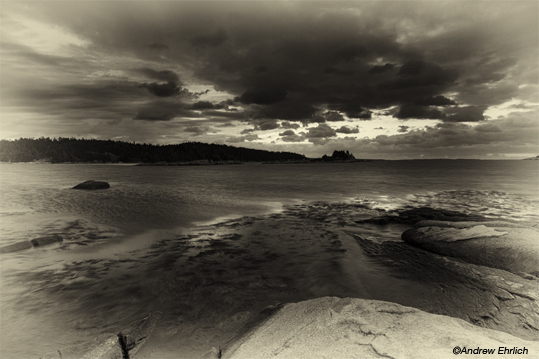
The majority of my photo life has been one deadline after another. Sometimes days, sometimes hours, and occasionally minutes. Approximately once a month, I try to take a half a day off, and kick back with my camera. So Happy Friday. Camera used for the above was a 5D Mark 3, 24-105 F4, tiffen 4x neutral density filter. Boy I miss black and white. Processed in Silver Effects Pro 2.

Joe D

Visual Impressions with Joe DiMaggio, Sponsored by Adorama
Adorama Learning Center
Adorama Workshops

Things ARE Bigger in Texas

©Joe DiMaggio

©Joe DiMaggio

Hi To All the Ships at Sea,

As photographers sometimes we tend to forget what it takes to make a fine photograph. There are other times, we stumble on a rock and the camera goes ‘click’, and something appears in the camera that looks good. You spend “x” number of decades trying to become more proficient at your visual literacy, and then one day you wake up and say “I’ve arrived! I’m good, actually I’m damn good.” Usually, within the next 72 hours, you wind up falling on your face. And it’s a brutal memory that you’re not as good as you think you are. I was fortunate enough to get a full-blown credential to the Formula 1 race in Austin, Texas. And to say I was a little excited is an understatement. On the same level, if I’m honest with myself I had some pretty big butterflies. It’s been awhile since I’ve been around Formula 1. I’ve gotta tell you, the above photograph brings you just a handful of really great people in Texas, who went way out of their way to help me do my job. I take my beret off to all of those great people, and I thank you to the bottom of my heart, for allowing me to come into your home and make some photographs. Please don’t succeed from the nation, we need Texas.

Joe D

http://www.adorama.com/
http://www.adorama.com/alc/
http://vimeo.com/dimaggiokalish

Email from friends, Sonja & Victor

©Joe DiMaggio

©Joe DiMaggio

This will be part of an Adorama TV Show that I did – This email is from a student we met in Corfu who had recognized me from the show and was a big fan. A very good looking and sweet couple.

Joe D

Hello JoAnne, Hello Joe,

I wish you a wonderful 2013, I know it is a bit too late, but Victor and me, we were in Rome, enjoying some beautiful days. We want to thank you so much for your beautiful Email, and we want to tell you that whenever you are in Europe, we will be more than happy to welcome you in Stuttgart. As a loyal Adorama TV watcher, where i have learnt so many techniques I usually apply when I’m taking pictures during my precious holidays, it was an overwhelming surprise to suddenly meet the master, Joe DiMaggio, himself on the beautiful island Corfu. An experience which made our holiday richer. Watching Adorama TV now became a new thing, somehow more personal.

Hear from you soon,
Sonja + Victor

January 21

© Joe DiMaggio

© Joe DiMaggio

To All The Ships at Sea:

Every day of our lives we have good and bad days, great days and devastating days.Today is devastating to the 10th degree for me. I lost my son Joseph today three years ago. An hour does not go by that I don’t think about him. Unfortunately, yesterday and tomorrow will be the same – the pain, sorry and love never go away. My dear son Joseph rest in peace. I loved you then and love you now.
Joseph DiMaggio III & Dylan Fire Truck 2  3e