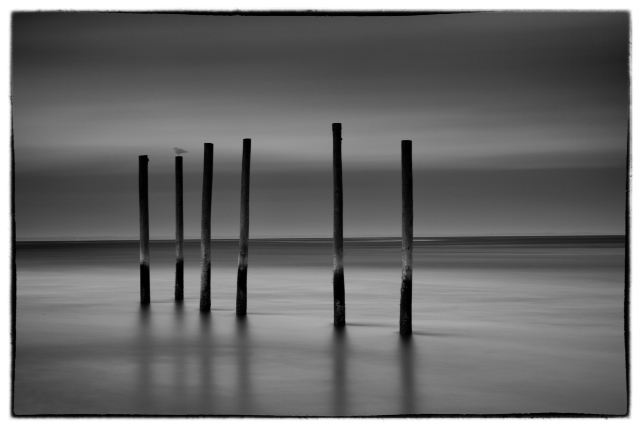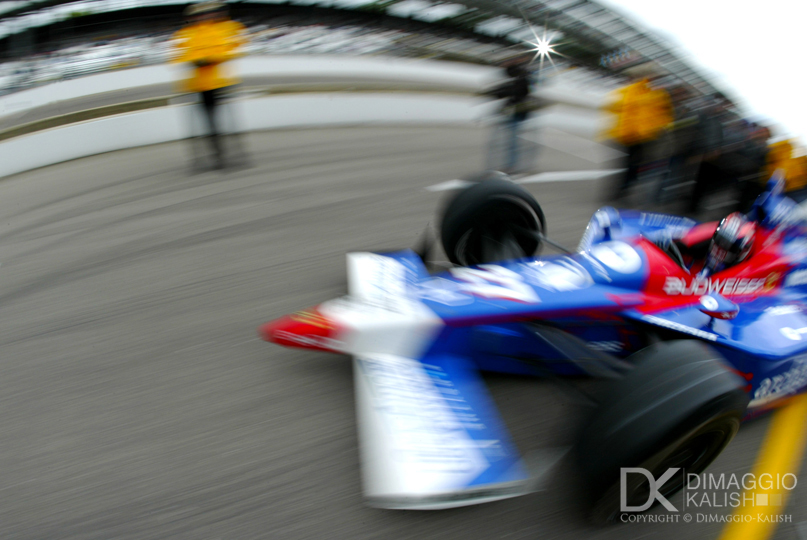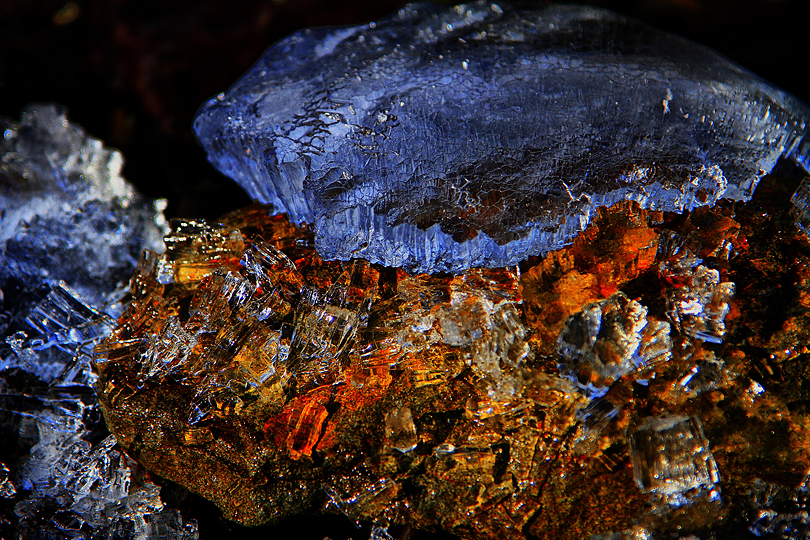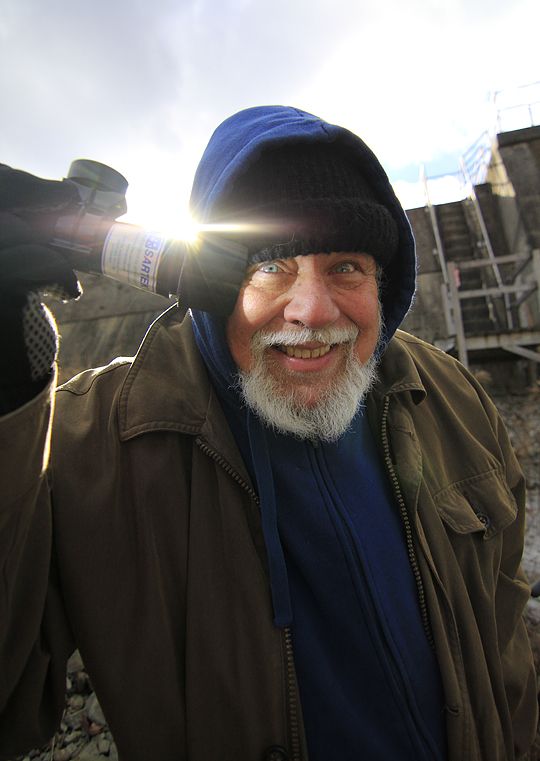
To all the ships at sea. If you ever have watched a true craftsman working on a 150 year old piece of oak and converting it to a gorgeous piece of furniture, what you quickly realize is that it’s all about his or her experience and their ability to utilize the tools of the trade. While producing a 1 minute spot for CBS, I approached it with traditional lighting and after two shoots, I decided to utilize two different Sartek underwater lights. For a few different reasons: Number one, the quality of light is a consistent 5800 kelvin. The burn time on the LED light is approximately 20+ hours. The angle of the beam gives me broad enough light to cover the ice formations from above, and also below. Obviously not at the same time. Oops! I forgot, I do have two lights. Carl Saieva is not only a great cave diver, and a super business person, but a fantastic design engineer. He has created these lights for use under 300 feet which is great, but when I dive I stay above 120 feet. 95% of all of the footage is 1080I. There are a few isolated stills. I’ll follow this blog up in a week with Carls mini-light which I utilize on the Go-Pro to get the camera and the light under the ice. JoeD
Category Archives: Uncategorized
Simply Elegant
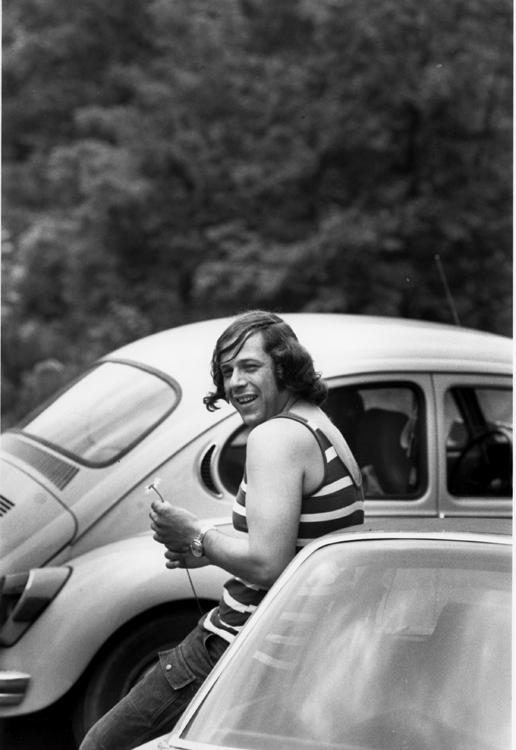
I met Andrew Ehrlich approximately thirty years ago. Andrew worked not only as my assistant, but as my studio manager. He loaded my camera on some of the most important shoots of my career. We became much more than a photographer and an assistant. I consider him part of my family and vice versa. Andrew went to NYU film school and went onto a career as a staff photographer with Avis and traveled all over the world. Andrew now has a beautiful wife and three dynamic kids. He is an extremely successful business man. On super major shoots, Andrew comes out of his retirement and works with me even today. I just received the above photograph in an email and when I looked at it my heart stopped. It is simple, it is clean, it is elegant, it is dynamic, and it is everything in a photograph that I love to see. I am totally elated when I see one of my protegés shoot something this magnificent. Andrew thanks for sending it and well see you Chinese New Year. JoeD
WHEELS VS. ICE hmmmmm
Bigger Is Better????
To all the ships at sea, I think it’s safe to say most Americans believe that bigger is better. For that matter, maybe everybody on the planet believes bigger is better. At last count, I believe I have three extremely large Gitzo

(Left Tall: Manfrotto 539Pro base and Manfrotto 503HDV head) (Left Under: Manfrotto 190CXPRO3 base and Manfrotto 701HDV head) (Right: Gitzo Studex tripod)
and Manfrotto tripods. These are the BIG boys. The older, larger Gitzo will hold over 200 lb’s. Please do not ask how I know what for sure. In addition to the repertoire, we have an extremely large Manfrotto carbon fiber which is awesome for large video work. In the mid-sized tripods I’ve lost count, but we certainly have four to five. Each with what I believe to be special application. Anybody who knows my works knows I like both Gitzo and Manfrotto standard monopods and more recently I’ve become a great fan of the Manfrotto video monopod (my DP and partners have been screaming for years “This is a good way to go” and of course, being the hard-headed person that I am, didnt pay much attention. But now I do and it is a great tool).
Now for the purpose of this particular blog. At the end of my repertoire of tripods is a super-light super-small Manfrotto 190 Pro3 with a 701HD video head. To be honest, I never paid it a whole lot of attention until I decided to do a 60 second piece for CBS Sunday Morning on ice, and a waterfall & damn covered in the stuff. Because the areas are extremely small and difficult to get to I decided to break out the 190 Pro3 tripod. Much to my surprise, it was unbelievably great. I was able to sneak into little nooks and crannies and got the 1080I footage I was looking for. My philosophy (and I believe I coined the phrase back in the day) is standardization and simplification are now going to standardize on this tripod for critical location work. Bigger is NOT necessarily better. And as we all know, it’s in the hands of the photographer or filmmaker. Keep your mind open for new ideas, and keep your eye constantly looking for new imagery. Believe it or not, it’s still there.
Happy New Year!
Happy Holidays to My Friends at Gleasons
To be Proper or Not
Old School / New School
Without fail, during the teaching process, one of the obvious questions is: “How much Photoshop work do I do?”. It may not be a stretch to say that some photographers may tend to exaggerate slightly. It could be fair to say that in my past life, I may have been just like that person. Lets get back on track. I do extremely minimal amount of Photoshop. Why you ask? Because I’m not very good at it. Why you ask? Probably because I do not apply myself and I have a full day of photography, film making, and editing. Id like to leave Photoshop to the experts. Over the years, I’ve been blessed with several great assistants who are able to do absolute magic with the tools in Photoshop. Scott Melanson is one of them, a graduate of CIA (Cleveland Institute of Art). Enya Mommsen, also an absolute wizard. Our newest assistant, Matt Tidridge has proven to be not only equal to the task, but in some ways, superior. We had a friend come in who had a 1908 photograph of his wife’s mother as a child and wanted to rebuild the image. I particularly thought of old-school in actually trying to restore the original print. Not happening! I pieced it together and shot the raw image, handed the file to Matt and he did his magic, which in my opinion is absolutely gorgeous. So I take off my beret to Matt, who can generate an original piece of art from a tattered, 100+ year old print. Knowing the tools, and how to use them, is a good thing.

Bill Eppridge in a Class by Himself
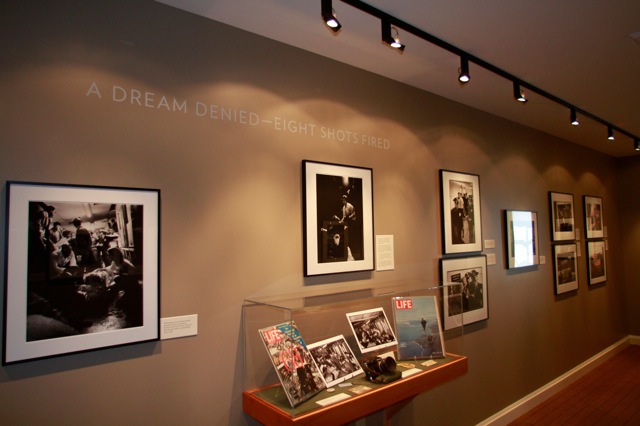
In my career I have been blessed with a few fortunate lucky right place, right time relationships. The first and foremost was attending the University of Missouri school of Journalism Workshop. It really doesn’t get better than that. The second would be assisting W. Eugene Smith who taught me more about communications then anyone. Actually, he taught me more about many things but for the purpose of this we won’t go there. When asked to deliver a keynote speech at the NPPA, one of the people I thanked was Bill Eppridge. I would love to tell you that I know Bill well but as the truth be known, that’s just is not so. But here’s what I do know. Bill Eppridge has very few peers. He stands alone with his great talent. He also has another quality that generally photographers don’t have. He’s an extremely humble about what he’s accomplished over the last few decades and he’s still a viable force to be dealt with. Bill invited me to his retrospective at the Fairfield Museum. Unfortunately, I was unable to attend. This past Sunday I had a little time off and decided to go to Fairfield, Connecticut to see the show. I thought I knew exactly what I was going to see. Boy, was I wrong. I had no idea the depth and scope of his work. Like many other photographers, we know about the positive RFK Photos, but the retrospective truly showed what an amazingly great talent he is. This is one of the few times I wish I was a great writer because there aren’t enough adjectives to express what an important body of work he has. Photographer Alfred Eisenstadt, once told me, he had maybe only a dozen fine photographs. When I had the audacity to tell him, “no you have thousands of great photographs,” he smiled, clicked his heels and said, “one day you will understand.”